How to Become Unpredictable in 7 Days (A Training Plan for Your Habits)
Willpower doesn't beat a habit. A rule that fires before the habit does can. Seven days, one rule each, a drill for every rule, and a number on your Watcher's File to show whether it worked.
The Dodgeye team4 min read
Here is how not to become unpredictable: decide to be. Everyone who tries to “just be random” produces the same tidy alternation the Watcher was practically built to read, and after ten hops they're back on their favourite side, slightly annoyed.
Behaviour-change research has a better answer, and it's boring in the way that works. Replace the habit with a competing rule, attach the rule to a trigger, practise in short sessions, and measure. Dodgeye happens to supply a trigger (every hop), short sessions (a level is about a minute), and a measurement (the Watcher's File). So here is a week.
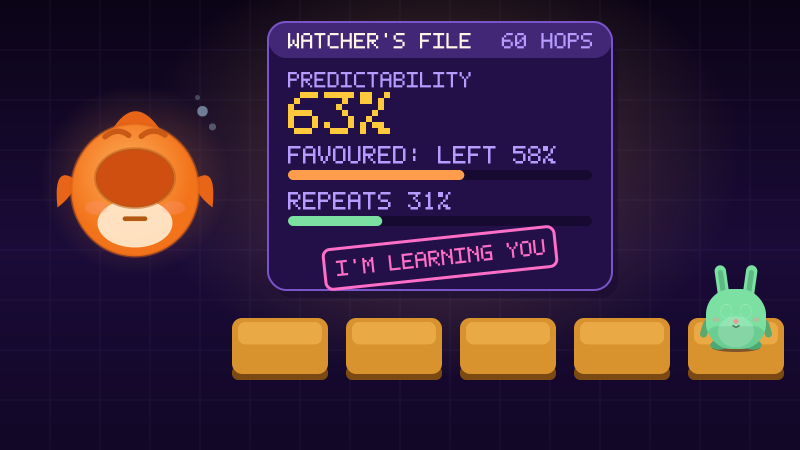
Two ground rules. One: play the Daily Challenge every day of the plan. It's the same board for everyone, twelve to fourteen hops, and it makes a fair before-and-after. Two: open your file on day one and write the three numbers down. Predictability, favoured direction, repeats. You'll want them on day seven.
Day 1. Look at yourself
Rule: none yet. Today is the baseline. Play three Meadow levels with the full readout on and, on each hop, say the Watcher's number out loud before you move. Notice which of its calls made you flinch. That flinch is your habit noticing it has been seen. Then open the file and write the numbers down.
Day 2. The tile you just used is off the menu
Rule: never land on the tile you landed on last hop. Drill: the City. The Parrot lives there and it exists to punish repeats, so a level like Neon Alley is the right amount of pressure. You only get the readout every third hop in the City; use the silent hops for the rule, not for thinking. What good looks like: the “Repeats under pressure” line drops within a session. It's the fastest-moving number on the file.
Day 3. Start on the wrong side
Rule: the first hop of every level goes to your least favoured column. Drill: ten levels, any world, first hop only. That's the whole drill. Why it works: your favourite side is the Watcher's fallback guess whenever it has nothing better, and the first hop of a level is exactly when it has nothing better. What good looks like: the first hop stops feeling wrong by level six or seven, and the favoured-direction share on your file starts to sag.
Day 4. Two speeds
Rule: alternate. One hop the instant the row opens, the next after a deliberate full beat, whether or not you've decided. Drill: Snow Peaks if you've reached it, because the Owl reads timing there; the Daily Challenge if you haven't. The trap to watch for: a pause that only happens before your unusual moves. If hesitation always means “something new”, it's a tell. Pause on the boring hops too.
Day 5. Bluff, then mean it
Rule: every feint has to point at your real tile about half the time. Drill: the Temple. Hover over a tile to fake a lean and drain the Watcher's Focus, then, half the time, take the tile you hovered. The Fox records hovers, and a fake that is always a fake is a signal. What good looks like: the Focus meter becomes something you spend on purpose rather than something that happens to you.
Day 6. Do the strange thing at the big number
Rule: when the readout is at its highest, that's where you break the pattern, not where you panic. Drill: Meadow and City, where the number is visible, plus one Endless run. In Endless the brain upgrades every eight rows, so it's a test of whether the rules hold as the opponent sharpens. Target: fifteen dodges in a row, which the game marks with LEGEND MODE, and which is far easier once the first five rules are automatic.
- hops in a Daily Challenge: the same board for everyone, your fair before-and-after
- 12–14
- hops per mode the file remembers, so a week of play replaces the old you
- 60
- dodges in a row lights LEGEND MODE, the day-six target
- 15
Day 7. Read the file again
Rule: all of them at once, on the Daily Challenge and three levels of your hardest world. Then open the file and compare the three numbers with day one. Predictability should be lower, repeats noticeably lower, and the favoured column closer to a third. If the verdict has moved from “an open book” to “I'm learning you”, the Watcher is telling you it lost something. That is the whole point of the week.
Then share the file. Not as a brag, although it is one. A shared file is a before-and-after your friends can try to match, and a friend who is sure they're unreadable is exactly the person this plan is for.
After the week
Habits come back. The file only remembers sixty hops per mode, so a fortnight of lazy play will quietly rebuild your favourite side, and the Watcher will be pleased to see it. Keep one rule a day in rotation, check the file on Sundays, and treat “an open book” as a reminder rather than a sentence. Being hard to predict isn't a trait. It's a practice, and now you have one.