How to Outsmart an AI That Predicts Your Moves (5 Proven Tactics)
A learning opponent is only as smart as the data you hand it. Five habits that starve the Watcher, why each one works, and which brain it beats. The same discipline works against any predictor that studies people.
The Dodgeye team5 min read
Most games ask you to be faster. Dodgeye asks for something harder, which is to be a little less like yourself for about fourteen hops.
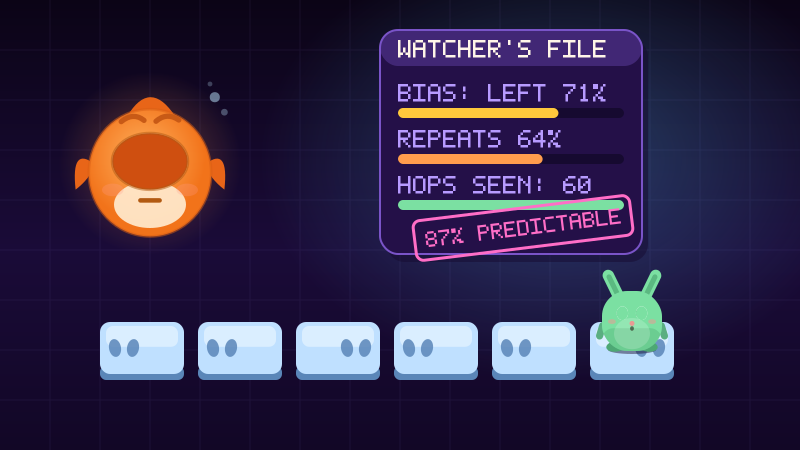
The Watcher studies your last sixty moves, finds the longest pattern of yours that keeps repeating, and fires at wherever that pattern says you'll go next. It shows you its confidence before it fires. Reflexes don't help much here. What helps is noticing your own habit one hop before the model does.
These five tactics each shut down a specific way it reads you. We didn't design them at a whiteboard; they're the five that kept coming up when we watched people learn the game, usually after a stretch of losing to a fish.
1. Never land on the tile you just left
Beats: the Parrot, the brain that reads repetition.
The simplest thing a predictor can learn is also the thing people do most: repeat. You went left and survived, so left feels safe, and that feeling is precisely what a two-move memory was built to punish. If your last hop was left, left is now the single tile the Parrot is most sure about.
So make it a rule rather than a feeling. The tile you just used is off the menu. That one habit drags a shallow brain's confidence down toward a coin flip, because you've deleted its favourite signal. In the City, where the Parrot lives and you only get a readout every third hop, this is most of the game.
2. Vary when you move, not just where
Beats: the Owl, the brain that reads rhythm.
The trap good players fall into is randomising where they go but never when. Everyone settles into a tempo. Snap decisions when you feel sure, a beat of hesitation when you don't. From Snow Peaks on, the Owl reads that rhythm alongside the tile, so two left hops can look completely different to it if one was instant and one was late.
The practical version: take one hop the moment the row opens, then hold the next for a full beat even when you already know your answer. And watch for the tell hiding inside your hesitation. If you only pause before doing something unusual, the pause is the unusual thing.
3. Bluff on purpose, never on habit
Beats: the Fox, the brain that reads feints.
You can hover over tiles before you commit. It reads as a lean, it drains the Watcher's Focus, and when the Focus is gone the Eye looks away for a hop. From the Fox onward, though, the hover itself gets recorded. If you always feint left before going right, your fake becomes the cleanest signal you produce.
So bluff the way it's done in any game that has bluffing in it: occasionally, deliberately, and sometimes truthfully. Hover a tile and then actually take it. A feint only stops being information when it points at your real move about half the time.
4. Do the strange thing when the number is highest
Beats: the maths itself.
This is the one that feels wrong. When the readout says 84% LEFT, most people feel caught and switch in a panic. Panic switches have patterns too. The better read is that a high number tells you exactly which habit the model has just committed to, and that is the best moment to break it, not the worst.
Think of it as risk against reward. When the Watcher puts 84% of its belief on one tile, every other tile is close to free. Its most confident moment is your safest window to do something it has never seen you do, and every time a confident call gets punished, the model has to distrust the very pattern it had learned best.
- moves the Watcher remembers
- 60
- a typical call, and always the model's real count
- 73%
- safe tile guaranteed on every row, no exceptions
- 1
5. Use the prediction as a resource
Beats: the idea that you're only defending.
Once you can anticipate where the beam will land, that's information, and it's yours. In the Temple you can angle a mirror so the Watcher's own beam ricochets into a wall and opens the coin behind it. On the ice, an Echo Swap trades you with your ghost mid-flight and turns a committed mistake into an escape. A dodger avoids the predicted tile. A strategist builds a plan around it.
The tactic underneath the tactics
All five come down to one discipline: read your own file before the Watcher does. The game keeps one on you, literally: your favoured direction, how often you repeat yourself, how readable you are, and you can share it if you're feeling brave. The players near the top of the Endless Ladder aren't the quickest. They're the ones who noticed what their file said and rewrote it mid-run.
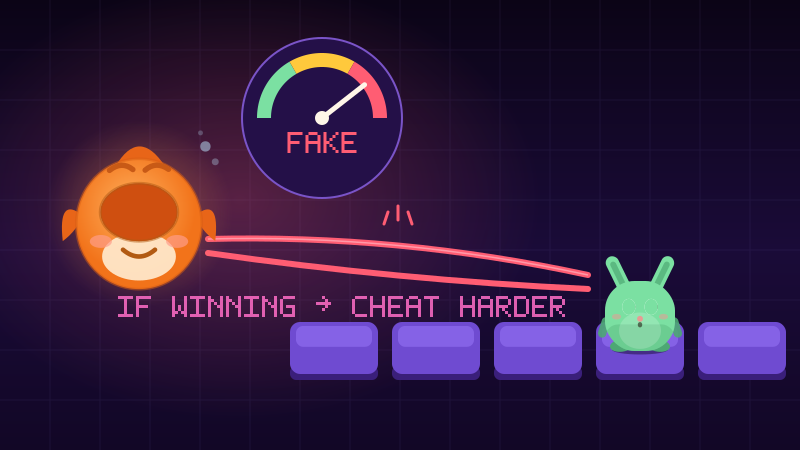
And unlike the opponents that quietly cheat, this one plays straight. It never sees your input before firing, the number is its real count, and at least one tile is always safe. When you beat it, nobody let you.
Questions people ask
Can you actually beat an AI that learns your moves?
Yes. A learning predictor is only as strong as the patterns you feed it. Break your repeats, vary your timing and stop bluffing on habit, and its confidence falls back toward a coin flip. A low-confidence AI is a beatable AI.
What's the single best strategy against a pattern-reading AI?
Attack your own habits before the AI finds them. If you remember one rule, make it this: the move that feels safest is usually the one it's most sure you'll make.
Does the Dodgeye AI cheat?
No. The Watcher never sees your input before firing, the confidence it shows is its real measured frequency, and a fairness guard keeps at least one safe tile on every row, even against the two-beam Oracle.