How to Read Your Watcher's File
Every Dodgeye player has a file. It's a handful of numbers and a verdict, it's built from your own hops, and it can be shared with the friend who thinks they're unreadable. Here is what each line actually measures.
The Dodgeye team4 min read
Somewhere between the third and the tenth level, most players tap STATS on the home screen, read the words THE WATCHER'S FILE ON YOU, and feel slightly accused.
Good. That's the intended effect. But a file is only useful if you know how to read it, and this one is built from real arithmetic rather than a personality quiz, so it rewards a closer look. Line by line:
Predictability
The big number. It answers one question: over the hops the Watcher currently remembers, how evenly did you spread your landings across the left, middle and right of the board?
Spread them perfectly evenly and the number is 0%. Land in one column every single time and it's 100%. Everything else sits between, and it's calculated with the same measure information theory uses for how much surprise a sequence holds. A player at 30% is genuinely harder to guess than a player at 70%, in the plain sense that there is less to go on.
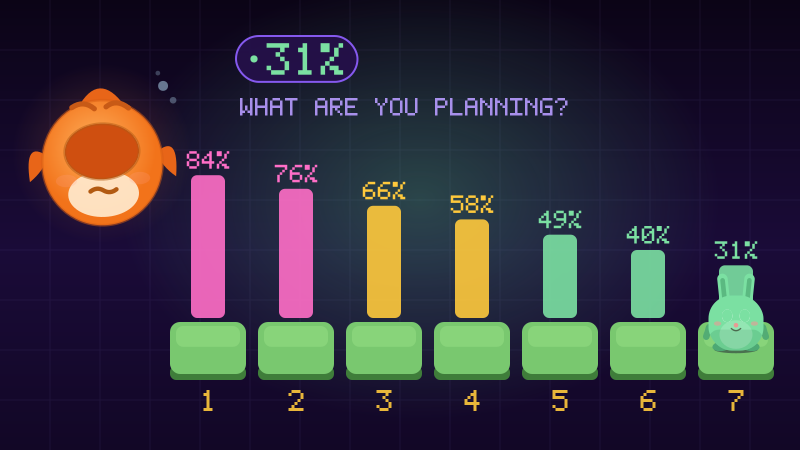
What it is not: the live confidence you see during a level. That number comes from patterns, timing and feints, and it can hit 80% on a single hop even for a low-predictability player who has one habit. Think of the file as your average, and the beam as the exam question.
Favoured direction
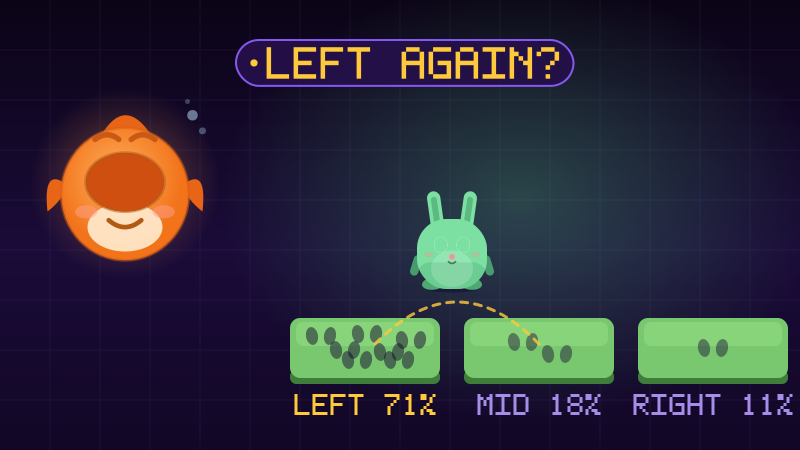
The column you land in most, and its share. LEFT 58% means that over the remembered hops, 58% landed in the leftmost column. This is the number the Watcher falls back on when it has no pattern to work with, which is why it matters more than it looks. The closer your top column sits to a third, the less the Watcher gets from this line.
Repeats under pressure
How often a hop landed on the same tile as the one before it. Repeating is the most common habit in the game and the first thing the Parrot learns to punish, so this is the line that moves fastest once you start playing deliberately. The rule that fixes it fits in a sentence: the tile you just used is off the menu.
Hops observed
How many hops the file is based on. This is not your lifetime total. The Watcher keeps a rolling memory of your last sixty hops in each mode, campaign, daily and endless, so the file is always about the recent you. A bad habit you dropped two weeks ago has already fallen out of it. So has a good one you stopped practising.
Below twelve hops the file refuses to judge you at all, because the Watcher shouldn't pretend to know a stranger.
The verdict
The line in quotation marks under the number is the Watcher's own summary, and it comes straight from predictability:
- “Too early to judge. Hop for me.” Fewer than twelve hops observed. Play a level.
- “An open book. I barely have to try.” 55% and up. You have a column you love.
- “I'm learning you. Give me time.” Between 29% and 54%. Where most of us live, and where most of us can move from.
- “Unreadable. Delicious. A worthy prey.” 28% and below. Your landings are close to evenly spread. This is the one to screenshot.
The progress lines
Levels cleared out of 40, your best endless row, your daily streak, and secrets found out of four. These aren't behaviour, they're a record, and they sit on the file so that a shared one tells a friend not only how readable you are but how far you've been.
Sharing it
SHARE MY FILE opens a page on dodgeye.com with your file on it: your name at the top if you've claimed one (an unnamed file reads UNNAMED SUBJECT, which is honestly quite good too), the readings, and the same verdict the Watcher gave you. The link is stable. Sharing twice gives the same address, so the one you pasted into a group chat last week keeps working. The page carries no rank and no leaderboard, on purpose. Predictability is a description, not a score to beat, and the only comparison worth making is with your own file a week from now.
Deleting your account closes the file, and the link with it.
Moving the numbers
Predictability comes down when your landings spread out. Repeats come down the moment you stop reusing tiles. The favoured direction fades when you deliberately start on the other side. The five tactics cover the beam; the seven-day plan is built around the file. Either way, check it before and after. It's the only report in the game that is about you.