Dodgeye: The Mobile Game With a Real Learning AI (No Scripts, No Fake Odds)
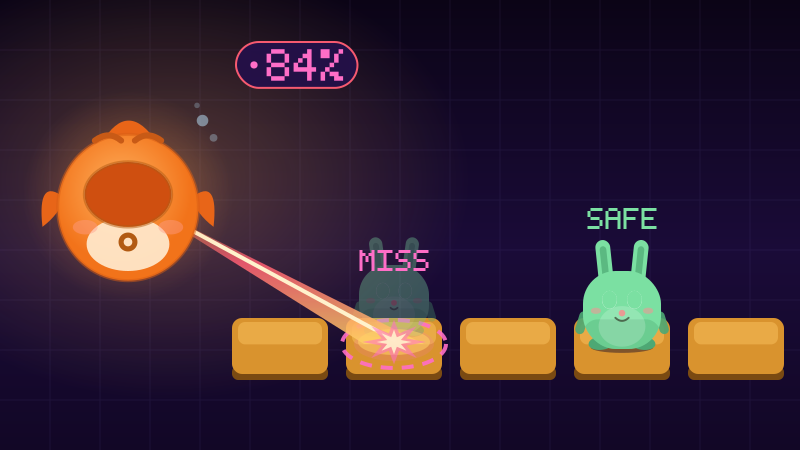
A cartoon fish with one enormous eye studies the way you play, tells you it's 73% sure you'll go left, and fires. The number is real. This is what we built, why we built it, and the three things we refused to do.
The Dodgeye team4 min read
The whole game in one hop
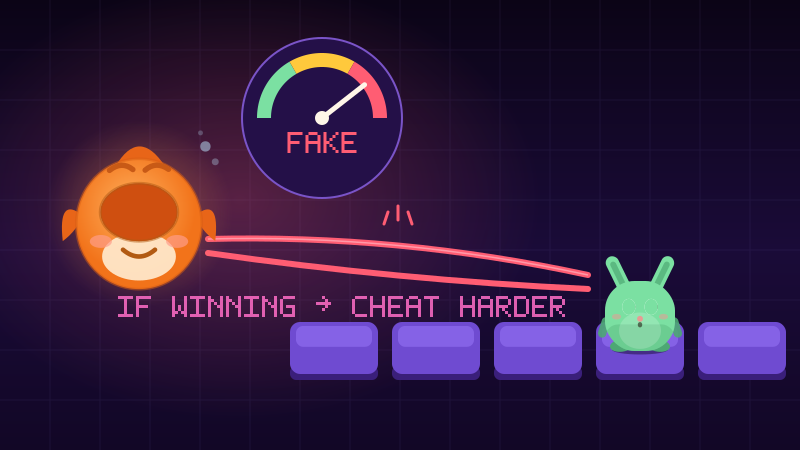
You play a small green bunny hopping along a row of tiles toward a gate. Floating above the tiles is the Watcher, a goldfish with one big eye and eight moods, and it does not like being surprised. Before each hop it guesses where you'll land, says the guess out loud with a percentage attached, and fires a beam at that tile. Land anywhere else and you're fine. Land where it said and you lose a heart.
That's the loop. Levels are eight to fourteen hops, you play one-handed, and a round takes about as long as waiting for a kettle. What took us most of a year was making sure the guess is never faked.
The number is the model's own opinion
The Watcher runs a variable-order Markov model, which sounds grander than it is. It keeps counts. After you've gone left, left, how often did you go right? After a fast hop, what usually follows? It remembers your last sixty moves in three channels: the tiles you pick, how quickly you pick them, and the tiles you hover over while pretending to pick them. Then it looks for the longest recent pattern of yours that has kept repeating and commits to it.
The “73%” it shows you is the frequency it counted for that pattern. We don't nudge it toward drama, and there is no difficulty slider quietly adding ten points in the later worlds. If the model is unsure, it says so, and it usually is for the first few rows, because it hasn't seen you do anything yet. Most game AI can't honestly say that.
All of this runs on your phone. No server round trip and no signal required, which is why the whole campaign works on a plane.
It gets harder by telling you less
Most games escalate by making the enemies faster or tougher. We didn't want that, partly because it turns a thinking game into a reflex test and partly because it would have meant meddling with the model. So the prediction is exactly as honest in world four as it is in world one. What changes is how much of it you're allowed to see.
- Meadow. The full readout every hop: the percentage and a ring on the tile it picked.
- City. The same readout, but only on every third hop. Silence in between.
- Temple. No numbers at all. The Watcher's pupil points at its pick, and that's all you get.
- Snow Peaks. Nothing. Nothing on screen correlates with the prediction.
The brain doing the predicting grows too. Goldfish only remembers your last move and is easy to shake. Parrot remembers two and lives to punish a repeat. Fox adds your bluffs. Owl adds your timing. The Oracle, which you only meet near the top of Endless, reads all of it and fires two beams at once. Each one needs a different counter, and we wrote those up separately.
You get to fight back
Dodging is fine. Outsmarting feels better, so most of the mechanics are about that. Hover over tiles before you commit to fake a lean; it drains the Watcher's Focus, and when the Focus is spent the Eye looks away for a hop. In the Temple you can line up a mirror so its own beam ricochets into a wall and opens the way to a coin. On the ice, tap mid-flight to swap places with your echo, the ghost of you on the tile you just left. We've watched people who were certain they'd been caught get out with that one.
Three ways to play
- hand-built levels across four worlds and three bosses, all of it offline
- 40
- Daily Challenge: one seed, the same board for everyone on Earth
- 1/day
- hops in the Endless Ladder, one heart, a sharper brain every 8 rows
- 200
There's also a way to become the Watcher. Freeze a ten-step plan, put up an entry of coins you've earned, and send it to a friend by code or link. They match the entry and get exactly one attempt. Whoever wins takes the prize, and every game is re-simulated on the server before a single coin moves.
What we refused to do
- No pay-to-win. Coins come from playing and only from playing. You can't buy them, so nobody can buy their way past you, against the AI or against a friend.
- No forced ads. The only ads are rewarded ones you choose to watch, for a hint reveal or a revive. Hints are display-only, so even those can't touch the outcome.
- No cheating. The Watcher never sees your input before it fires. A fairness guard leaves at least one safe tile on every row, even against the two-beam Oracle. Ranked runs are replayed on the server so nobody can fake a score, including us.
Why we bothered
Because the most interesting opponent in any game is one that knows you. Every round is a small report on you, your favourite side, your rhythm, your favourite fake, turned into a live percentage by a fish that is visibly pleased with itself. There is real science behind that, and it was too good to leave in a journal. Most puzzle games ask whether you can spot a pattern. This one asks whether you can stop being one.
Dodgeye is out now on the App Store and Google Play, and it's free. If you'd rather test yourself first, the homepage has a live predictor that will happily read you in your browser.