Can AI Predict Human Behavior? We Built a Game to Prove It
Yes, well above chance, and with maths you could do on paper. The uncomfortable reason is that people are bad at being random. We turned that finding into a game in which the predictor has to show you its number before it fires.
The Dodgeye team4 min read
Try something. Think of a random sequence of lefts and rights, twenty of them, as quickly as you can.
Whatever you came up with, it almost certainly wasn't random, and it wasn't random in a predictable way. Psychologists have been running this experiment since the 1950s. Ask people to produce a random string of choices and they alternate too often, avoid long runs, and quietly keep the totals balanced, because to a person “LLLL” doesn't look random, even though a fair coin throws runs like that all the time. Your idea of randomness has a structure. Structure is what a predictor eats.
You don't need a big model
The part that surprises people is how little machinery this takes. Predicting a constrained human choice, left or right, this tile or that one, doesn't call for a large language model or a data centre. It calls for one question: given what this person just did, what do they usually do next?
That's a sequence problem, and a very old tool answers it. A variable-order Markov model, sometimes called a context tree, keeps counts for every recent context: your last move, your last two, your last three. When it's time to guess, it checks which context length has been the most reliable signal about you lately, trusts that one, and reads off the answer.
In the early fifties, Claude Shannon and David Hagelbarger at Bell Labs each built a machine that played a coin-matching game against people using not much more than that. Neither was clever in any modern sense. Both won more often than they lost, because the people playing them kept repeating themselves. Every rock-paper-scissors bot that has beaten humans since is a variation on the same idea. The machine isn't reading your mind. It's reading your history, and your history is more repetitive than you'd like.
So we built the experiment as a game
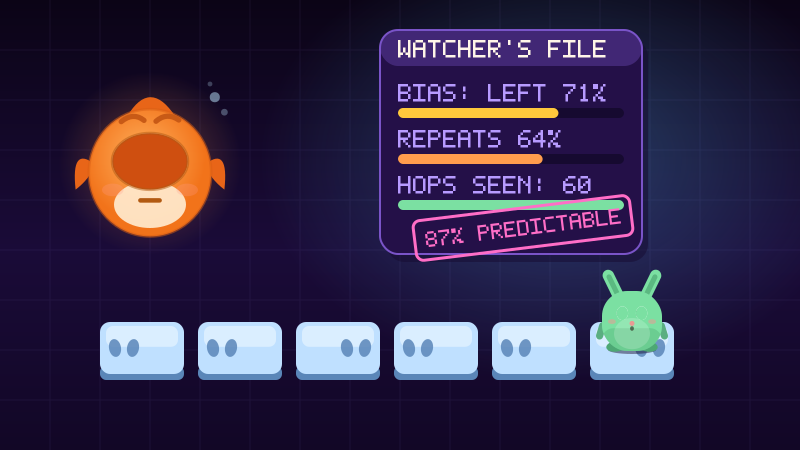
Dodgeye is that finding turned into something you can play one-handed on a phone. The predictor, which we call the Watcher, keeps your last sixty moves in three channels:
- Tiles. The trail of where you hop, move after move.
- Timing. Your rhythm: snap decisions against deliberate pauses.
- Bluffs. The tiles you hover over while feinting. Your fakes are data too.
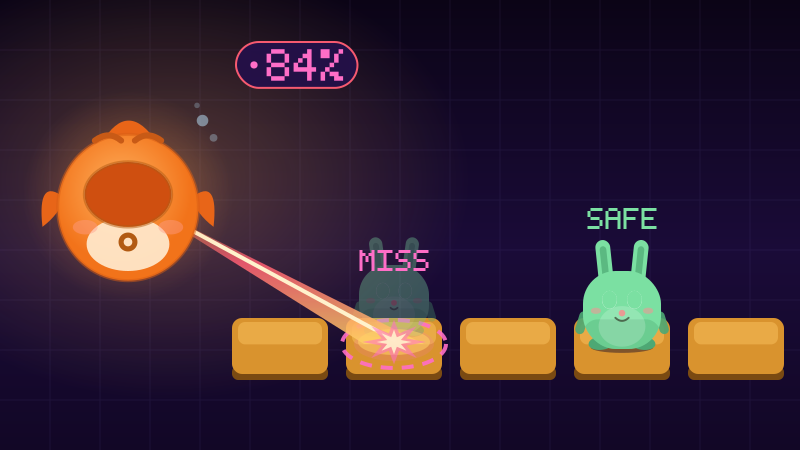
Each hop it finds the longest recent pattern of yours that keeps repeating, announces its confidence, “73% you'll go LEFT”, and fires at that tile. The percentage is the frequency it actually counted for the pattern it matched on you. Nothing is added for drama and there is no difficulty dial behind it. Which makes every round a small, honest replication of the experiment: can this simple model out-predict your best attempt at being random?
Usually, at first, yes. That's the humbling part. It's also the reason people keep playing.
Why we show you the number
Most predictive systems hide their confidence. We put it on screen on purpose, because the number changes what the game is about. A hidden prediction is spooky. A visible one is a dare. When the Watcher says 84% to your face, what it's really saying is: this is the habit I found in you. You can flinch, or you can break the habit right there.
It also turns every hop into a small risk-and-reward decision. A coin sitting on the tile the Watcher has just called at 80% is a genuine risk. The same coin under a 40% call is nearly free. Honest numbers make the risk legible, and that is the difference between a strategy game and a game of pure luck.
- channels it reads: tiles, timing, bluffs
- 3
- server round trips. The prediction runs on your phone
- 0
- of the numbers it announces are its own real count
- 100%
Where prediction breaks
This is the honest flip side, and it's also how you win. A behavioural predictor has no access to your intentions, only your record. The moment you genuinely decouple from your own history, by breaking a repetition, shifting your tempo, or feinting against your habit, its matched patterns stop paying off and its confidence falls back toward chance. It cannot predict what has no precedent.
That's the game in one line: AI predicts people exactly as well as people behave like their past selves. Dodgeye makes the contest visible and, because a fairness guard always leaves one safe tile, winnable. The tactics that beat it are the ones that would beat any predictor. Become bad training data.
Try it on yourself
There's a live version of the predictor on the homepage. Give it ten moves of your best random and watch what confidence it reaches. Most people don't love the answer. That's exactly why it's worth ten moves of your time.