Most Game AI Is Fake: How Rubber-Banding Tricks You
The racer that's always on your bumper. The enemies that “adapt” the moment you start winning. Most of it is stagecraft, and the industry has good reasons for the trick. Here is how it works, and what an opponent that actually learns looks like instead.
The Dodgeye team4 min read
Everyone who plays games has felt it. You're leading a race by half a lap and somehow the pack is on your bumper again. You're cruising through a shooter and the enemies sharpen up right as you get comfortable. It feels like the game is reading you.
It usually isn't. It's reading your score, and quietly moving the goalposts.
The three great fakes
Rubber-banding
The oldest trick in racing games. Cars behind you get faster, cars ahead of you slow down, as if the whole field were tied to you with elastic. There's a defensible reason for it, since a race decided at the first corner is a boring race, but it means the “AI drivers” aren't out-driving you. They're being towed into contention by a rule. Kart racers layer item systems on top that hand the strongest weapons to whoever is losing, which is the same elastic in a costume.
Dynamic difficulty adjustment
Subtler, and far more common than players realise. The game watches your numbers, deaths, accuracy, ammo, and quietly tunes the world around them: a fuller crate, spongier enemies, gentler spawns. Some very well-made games do this. Resident Evil 4 famously ran a hidden difficulty scale, and Left 4 Dead's “AI Director” is essentially a thermostat for your stress level. It's effective, and it's often good design. But it isn't intelligence. The enemy never learns a thing about how you play. A dial moves.
The cheating opponent
Classic strategy games earned their reputation for brutal AI on the highest settings mostly by handing the computer more stuff: extra resources, free units, sight of the whole map. The opponent isn't smarter on hard. It's richer. Fighting games have their own version, the boss that “reacts” to your button press because the code sees the press before your character has moved.
Why studios do it, and why it isn't a scandal
In fairness to the people who build these systems: fake AI exists because it works. Scripted opponents are testable, cheap to run, easy to tune, and they reliably produce the emotional arc most players actually want, which is tension, a close call, and then a win. A genuinely learning opponent is harder to build, harder to balance, and can produce the one outcome a mass-market game can't afford: a player who feels hopelessly outclassed by arithmetic.
So the industry made a sensible trade. The illusion of intelligence with the reality of control. The only real dishonesty is the store page that says “adaptive AI” over code that says: if the player is winning, cheat harder.
What an honest opponent looks like
We built Dodgeye to be the counter-example, and being honest about the AI forced four specific decisions:
| Fake AI does this | The Watcher does this |
|---|---|
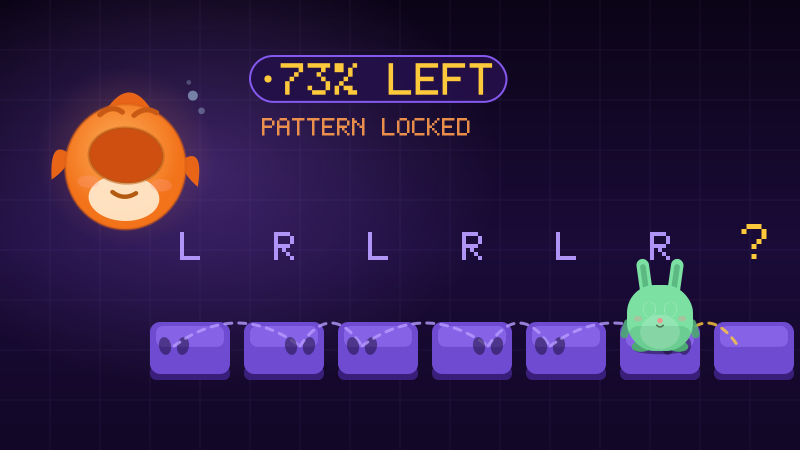
| Reads your score and adjusts a hidden dial | Reads your behaviour. A real variable-order Markov model learns your tile, timing and bluff patterns, on your phone. |
| Hides how it works | Announces its prediction and its true confidence. “73% you'll go LEFT” is a counted frequency, not a script. |
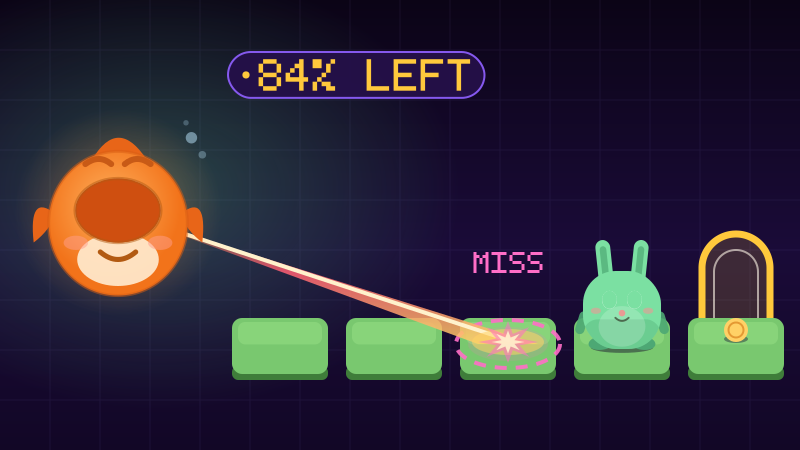
| Peeks at your input to “react” | Never sees your input before firing. It commits first. The dodge is genuinely yours. |
| Gets harder by getting stronger, or by cheating | Gets harder by telling you less: full readout, then every third hop, then gaze only, then blind. The maths never changes. |
That last row is the design decision we're proudest of. Once the predictor is real you don't need to rig it to scale difficulty, because you can scale information instead. The model is identical in the Meadow and in Snow Peaks. What changes is how much of its thinking you're shown, so getting better means getting better at reading, not grinding a stat.
The trust problem
Claiming “our AI is real” costs nothing, and every store page says something like it. So Dodgeye backs the claim with structure rather than adjectives. The model runs entirely on the device, with no server call that could slip something in. Every ranked run is re-simulated on the server and validated, so scores can't be faked, by players or by us. And a fairness guard guarantees at least one safe tile on every row, even against the Oracle at the top of Endless, which fires two beams. A rigged game has to hide its rules. An honest one can afford to publish them.
The payoff is a feeling rubber-banding can never manufacture. When you finally outsmart the Watcher, nobody eased off. You beat the count.