Why Humans Are So Predictable: The Psychology of Patterns
Your brain is a prediction engine, brilliant at spotting patterns and constitutionally unable to stop producing them. The psychology of habits, the “it's due” feeling and behavioural tells, and how a very simple statistical model takes advantage of all of it.
The Dodgeye team4 min read
Play rock-paper-scissors against a competent prediction bot for fifty rounds while trying as hard as you can to be random. You will lose more than you win. Not because the bot is brilliant, but because you can't stop being you.
Predictability isn't a personal flaw. It's the operating principle of the brain. Understanding why is the first step toward something genuinely hard, which is breaking your own pattern on purpose.
A brain built to predict is a brain built to repeat
A widely held view in cognitive science is that the brain is, at bottom, a prediction machine: it forecasts what comes next, compares that against what actually arrives, and updates on the difference. That's why you can catch a ball, finish a friend's sentence, and drive a familiar route without remembering any of it. But a system optimised for prediction has a side effect. It produces predictable output. Efficient brains cache their decisions. Once a choice works, the circuit that produced it gets cheaper to run, and cheap circuits win the next race. That's all a habit is: a decision your brain declines to make twice.
In behavioural terms the loop is famous: cue, routine, reward. In a game it's brutally compact. This tile felt safe, you hopped there, you survived, so that tile feels safer. Three rows in, you have a bias you never chose. Sixty moves in, you're a dataset.
The randomness illusion
The deeper problem is that even when people try to be unpredictable, they fail in patterned ways. Studies of random sequence generation have been showing this since the 1950s. Ask people to write down imaginary coin flips and they reliably:
- Over-alternate. Real randomness produces runs. HHHH happens. People avoid runs because runs don't look random, which makes the alternation itself a tell.
- Balance too eagerly. After three lefts, right feels “due”. It isn't. Independent choices don't remember each other, but people treat the universe as if it were keeping score.
- Anchor under pressure. Stress narrows options. In fast decisions people default to the recent, the rehearsed and the rewarded, which is exactly the set of moves a history-based model has already logged.
The cruel part is that your strategy for being random is itself a pattern. A predictor doesn't need to read your mind. It needs to read your idea of randomness, and that is far more consistent than you'd like.
You leak more than choices
Choice is only the loudest channel. Anyone who has stood in front of a penalty kick knows the quieter ones: the length of the run-up, the glance at a corner, the little hitch before the strike. Reaction time carries information about internal state. Snap decisions signal rehearsed moves; hesitation signals conflict. And feints, ironically, are often the most habitual thing people do, because we rehearse our deceptions even harder than our honest moves.
This is exactly the stack a modern behavioural predictor reads. In Dodgeye the Watcher's brains add these channels one at a time: the Parrot reads repetition, the Fox reads your hover-feints, the Owl reads your tempo. Each world of the game is, more or less, one section of this article turned into an opponent.
How simple maths takes advantage
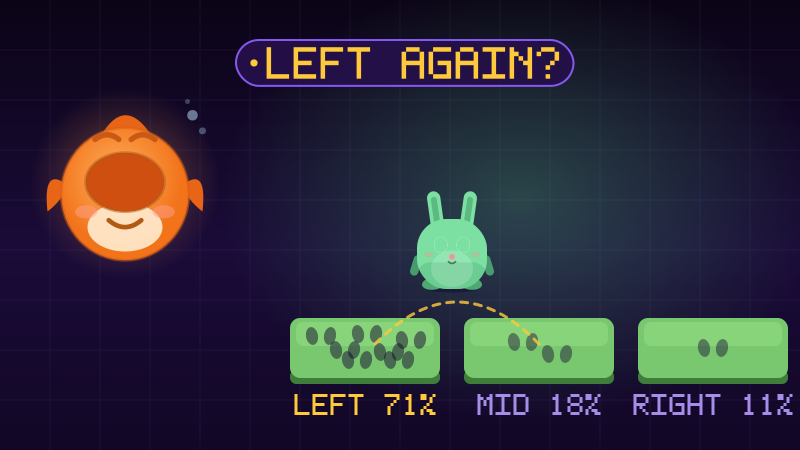
The model doing the exploiting doesn't need to be exotic. A variable-order Markov model keeps counts. After the context “L, L”, how often did this person go right? It checks your current situation against every recent context length, trusts the longest pattern that has been reliably repeating, and outputs a probability. Over-alternation, “due” thinking, pressure anchoring, rehearsed feints: every bias above shows up in those counts as a frequency the model can simply read off. Human psychology does the hard work. The maths takes attendance.
- how often a fair coin alternates. People go well above it
- 50%
- moves of history the Watcher counts you on
- 60
- habit broken on purpose is enough to dent a prediction
- 1
Why breaking a habit is genuinely hard
Knowing about your bias doesn't dissolve it, because habits don't live where knowledge lives. They fire ahead of deliberation; that's their job. Behaviour-change research keeps landing on the same result: suppressing a habit head-on tends to fail under load, while substituting a competing response and disrupting the cue works much better. In game terms, don't vaguely “try to be random”. Adopt explicit counter-rules. Never repeat the last tile. Alternate your speed on purpose. Occasionally hover your true target. Let the rules override the reflex. That is precisely the tactic set that beats a learning AI, and it transfers: the same discipline reads as unpredictability on a football pitch, across a chessboard, in a negotiation.
A mirror you can play
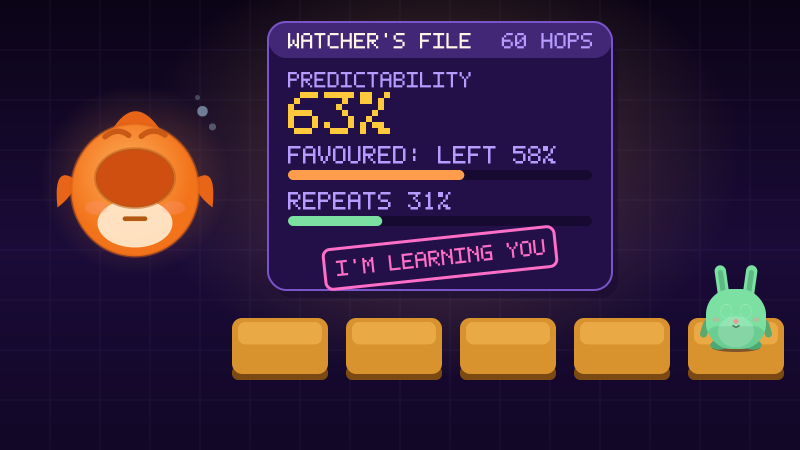
What makes facing an honest predictor strange, and strangely useful, is that it holds up a file no friend could: your favoured side, how often you repeat yourself, how readable you are, as a number. The game literally keeps one, the Watcher's File, and you can share yours. Every confidence call is a small psychology report about you specifically. Most brain games test whether you can spot patterns. This one tests whether you can stop making them, and that turns out to be the rarer skill.